
Having provided SEO services to clients for more than ten years, MaxWeb Solutions understands just how important Google Reviews are for any SEO strategy. To ensure that you are aware of the importance of Google Reviews for your SEO, we delve into Google Reviews and their impact on your SEO here.
Many businesses underestimate their impact, but reviews now play a major role in local SEO and conversions. Put simply, Google reviews influence rankings, clicks and trust. If you’re looking to boost your local online presence and to reach people in the places you operate, the importance of Google reviews for SEO cannot be overstated.
In this article, we’ll look at how reviews affect Google rankings and provide you with clear, actionable insights to help you make the most of this important feature.
What Are Google Reviews?
Google reviews are customer reviews left on Google. These reviews will appear in your Google Business Profile listing and Google Maps. More than 90% of people read online reviews before making a purchase decision, and Google reviews are very accessible if you have a local Google Business Profile.
Generating Google reviews can also influence your position in the map pack. This can help you increase your reach and build trust with potential customers.
Do Google Reviews Help SEO?
Yes, getting Google reviews can certainly help your SEO.
Key Google reviews local SEO impacts include:
- Boost to local rankings via the Google Map Pack
- Improved click-through rates
- Clear trust signals for customers
How Google Reviews Impact SEO Rankings
Reviews and The Local Map Pack Rankings
The Google Map Pack, or Local Pack, is the Google Maps listing that shows, along with the top 3 or more businesses providing a product or service in a local area connected to the search term.
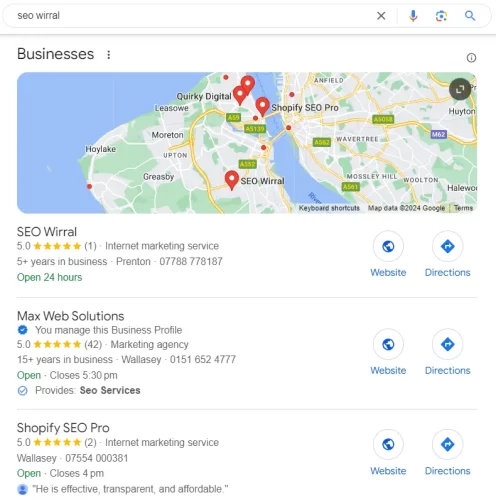
Here you will find the business name. phone number, directions, link to website, reviews, and other information, such as opening hours or business specialities. Getting your business to display on this Map Pack for relevant searches is hugely important for local businesses in terms of visibility and clicks
There’s a big connection between Google reviews and Map Pack ranking. In fact, along with proximity, reviews are a primary ranking factor for the Map Pack. The quantity or volume of reviews is important, but so is freshness, with recent reviews indicating the business is a going concern.
Your Click-Through Rate (CTR)
The ratings on any Google reviews you have are actually less important in terms of SEO than the volume and freshness, but they can be very important for customer trust and conversions.
SEO gets your business seen, but you must still convince the customer to click, and that easily visible star rating can make all the difference.
Trust and Credibility
Consumers increasingly use reviews as important trust signals. It’s always a good idea to keep in mind Google’s EEAT framework, which stands for Experience, Expertise, Authoritativeness and Trustworthiness.
You can’t control what customers say in a review, of course, but you can provide a service that measures up and reply to reviews to bolster these signals.
User-Generated Content and Keywords
Reviews essentially provide user-generated content (UGC) for free. Reviews contain natural keywords and even pictures, and it’s important to get a wide range of diverse reviews, as this can help the business identify with more keywords. Ideally, we would like to get reviews talking about products, delivery, customer service, value, ease of use, issue resolution and in-depth user experiences.
If your business has lots of 5-star reviews with ambiguous replies such as “great service”, this is not as helpful as a detailed review, either in terms of user value or SEO. Google itself suggests that a paragraph is the perfect length for a review.
Whilst we can not dictate how many words a customer uses when leaving a review, we can encourage them in the wording we use when asking for a review. Detailed reviews are more helpful from a customer perspective, so this should be encouraged where possible.
Review Recency
The rate and frequency you pick up new reviews can be very important Google review ranking factors.
If a business once picked up a lot of reviews but these have since dried up, it could indicate that people are no longer using this business as much as they once did.
New reviews can also be seen as more relevant than older reviews as they will more accurately reflect the services, products and customer experience at the present time. Consistency of reviews is also preferable to spikes in both volumes and ratings, which could indicate temporary changes rather than the regular service offered.
Search engines will monitor the frequency of Google reviews so they can promote businesses that are performing well right now and not historically to local search users.
How Much Do Google Reviews Influence Rankings?
Google never explicitly confirms the exact weighting given to reviews and other SEO elements, but careful observation, practice, and analysis reveal that reviews are a major part of the ranking algorithm and influence the Map Pack.
It makes sense; each review is a form of approval or disapproval by real customers. Businesses with a lot of good reviews should benefit from a higher ranking in local SEO, as Google wants its users to be satisfied with the results it returns through Google search.
Google reviews are, of course, only one part, but they should be seen as an important element within a wider SEO strategy.
How to get more Google reviews
Now we have established that Google reviews are important from an SEO perspective, you may be wondering how you can gain more Google reviews.
This is entirely up to the customer, but there are some things you can do to encourage them…
1. Ask at the Right Time
The best time to ask for a review is after a positive interaction, such as when a customer has made a purchase or used a service to their satisfaction.
2. Make It Easy
People generally don’t want to spend too much time or effort on reviews. Providing direct ‘review links and QR codes can make things easier.
3. Use Email Follow-Ups
Opt-in SMS or email marketing follow-ups can be used to gently nudge customers towards providing a review, with simple guidance and direct links.
4. Use Physical Prompts (e.g. QR Codes / NFC)
Links and QR codes can be placed within on-premises signage, invoices, menus etc. You can also reference solutions like Tap On Reviews but keep things subtle rather than hitting the customer over the head with demands.
5. Train Your Team to Ask
A short, polite request from a team member asking if you’d like to leave a review can be more effective than written requests. You could also provide cards with links and instructions so the customer doesn’t feel pressured to respond there and then.
Common Mistakes to Avoid with Google Reviews
It may seem tempting but leaving or even paying for fake reviews can be one of the worst things you can do. Google actively looks for fake reviews using sophisticated algorithms and can penalise listings with ranking drops, removal from Google Maps or even permanent suspension.
Customers are also increasingly savvy and can often spot fake reviews, resulting in a major hit to trust and reputation.
A less serious but common mistake is failing to respond to reviews. You don’t have to respond to every single review but addressing complaints or concerns can improve your trust signals.
Large gaps in review activity can look odd or suspicious, even if they’re not. You can’t guarantee customer reviews but keep your efforts to gain them consistent.
Does Responding to Reviews Help SEO?
Responding to reviews signals to Google (and customers reading the reviews) that you are currently active, legitimate and trustworthy.
This can give at least a small boost to SEO but also reinforces engagement and trust with customers.
There can also be indirect benefits such as identifying areas for improvement in the case of legitimate comments and complaints.
Google Reviews vs Other Review Platforms
Google is not the only platform that hosts reviews. Platforms like Trustpilot, Yelp, TripAdvisor and Facebook can all be important sources for reviews and you might also encourage reviews to be left on your own website.
All have their value, which can vary depending on your business type. TripAdvisor is great for tourism and accommodation, for example, while Trustpilot can be important for e-commerce.
In terms of SEO and especially local SEO, however, Google remains the priority. Google reviews have the highest visibility for local searches. It is a highly trusted platform and is easy to use for customers.
Google reviews also directly affect your local search rankings and, as Google is by far the biggest search engine in both the UK and globally, this has a major impact on your SEO.
Google Reviews and SEO FAQs
Do Google reviews improve rankings?
Yes, Google reviews improve local search and Map Pack rankings, as well as providing other benefits such as improving trust with potential customers.
How many reviews do you need to rank?
There is no ‘magic number’ but in general 5 reviews may be considered a basic establishment of credibility. There may also be review ‘thresholds’ that give you a boost at certain points such as when you reach 15-25, 40-50, 75-100 or 150+ reviews.
Are recent reviews more important?
Yes, recent reviews are generally considered more important. They indicate that you are a going concern and reflect what customers are thinking and experiencing now rather than in the past.
Get Help Growing Your Organic SEO
Google reviews impact both rankings and conversions and proactively seeking positive reviews should be seen as an essential part of an overall SEO strategy.
Maxweb are experts in all aspects of local SEO, including strategies to make the most out of Google reviews.
Find out more about our specialist SEO services or contact our friendly, experienced team today.
Posted on Monday, April 13th, 2026 in SEO.