

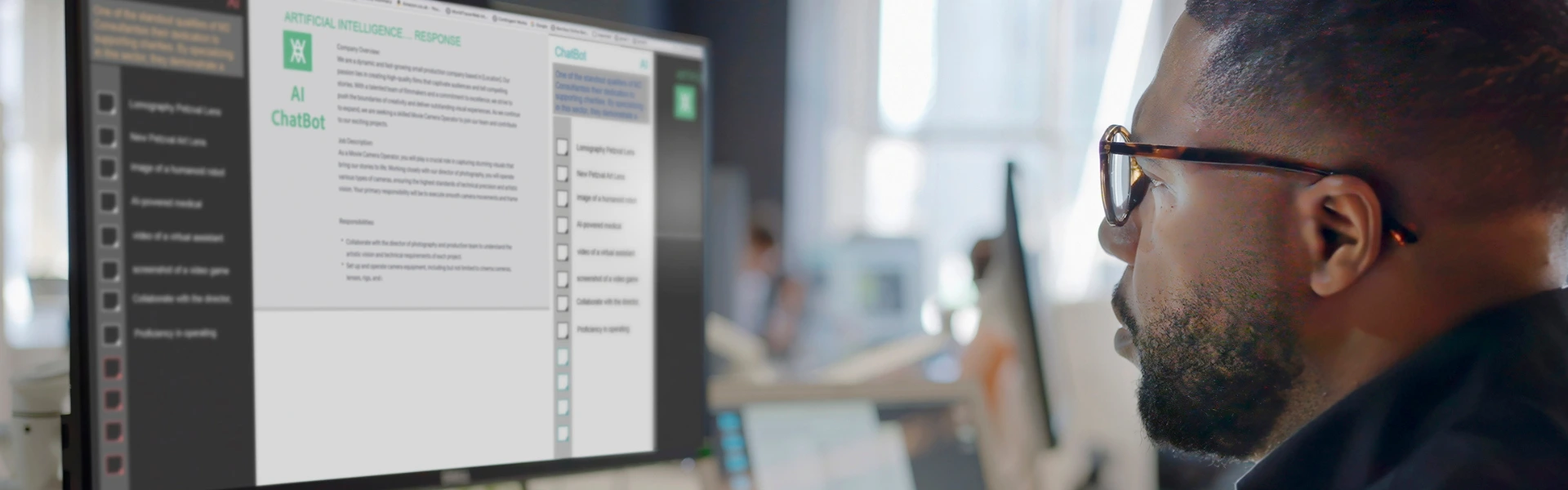
AI is no longer a disruptive force within our society. It is quickly becoming a foundational technology, with applications such as ChatGPT becoming a standard marketing tool, helping organisations create content faster, improve efficiency, and support SEO efforts.
While AI offers significant benefits for content creation, there are limitations around creativity, accuracy, and maintaining a consistent brand voice. This technology is going nowhere, so it’s important to practise responsible use, balancing AI’s capabilities with human expertise, oversight, and originality.
Risks of Using ChatGPT
Using any tool, especially ChatGPT, doesn’t come without risks.
Sometimes, It’s Just Plain Inaccurate
ChatGPT can produce outdated information from previous training data or incorrect information from unverified sources, like comments on Reddit. AI can also produce hallucinations, completely invented facts and information, such as imaginary statistics or non-existent studies. This occasional lack of factual accuracy can be a concern, especially in industries such as healthcare. This makes fact-checking essential.
Lack of Creativity
While ChatGPT produces structured content quickly, what it creates can feel generic or repetitive. It relies on common phrasing and patterns, limiting originality and reducing the insight available or natural storytelling that human writers provide.
It Lacks a Human Writer’s Touch
AI struggles with tone, empathy, and emotional nuance, which can lead to content sounding, well, not human. This can affect brand voice consistency, as it may not maintain a style across content without being properly guided. Human writers are likely to sound more authentic and be aligned with their brand identity.
AI-Generated Content Can Impact SEO (And Not In a Good Way)
Search engines, like Google, prioritise high-quality, original content that answers users’ questions. Overuse of AI can result in shallow, bland content that, over time, will underperform. Human input ensures more accuracy, depth, and likely stronger SEO outcomes.
How Businesses Use ChatGPT Successfully
Businesses are quickly adopting ChatGPT for content creation purposes. A survey from last year found that 50% of those asked use tools like ChatGPT to support their existing content creation strategies.
So, how do businesses use ChatGPT?
- Content ideation: ChatGPT is good at using prompts provided by humans to create numerous content ideas, generating ideas for niches in a broad topic, finding new angles and using current news and trends to come up with relevant ideas.
- Blog outlines: ChatGPT can quickly create outlines with headings and subheadings that flow naturally and provide a good framework for content creators to work off of.
- Meta descriptions: These are the elevator pitch for your pages that can improve a page’s click-through rate. ChatGPT can generate various options within the character limit, so they are not cut off by Google, including keywords and a CTA.
- FAQ generation: FAQs answer users’ burning questions, and these answers now appear in the AI overview portion on Google. ChatGPT can be used to generate FAQs that match user search intent, and you can use it to format the section into FAQ schema markup, which is important for technical SEO.
- Content briefs: ChatGPT can be used to create standardised templates for content briefs, producing these briefs quickly with all the relevant information for content writers to work off.
- Internal documentation: Companies can use ChatGPT to create documents within the businesses, templates for all company documentation, turn notes into proper handouts at meetings, handbooks and improve existing documents, creating consistency across the business.
How Google Views AI Content in 2026
Google is a company that is now a leader in AI. This doesn’t mean it is biased towards or against AI content writing; the only real concern is quality.
Google’s algorithm is built now on prioritising content that is people-first, not search-engine-first, guided by their helpful content principles. Google wants to provide answers to its users, so it ranks content highly that does that, rather than content that wants to pander to search engine algorithms stuffed with keywords.
Though AI is not viewed negatively by Google, completely written AI content is unlikely to do well, SEOs are finding. Semrush found that 72% of AI content ranks at least as well as human content, but that the number 1 results are 8x more likely to be human-written.
AI is becoming more widely and heavily used by marketers to help produce content. This content is likely not to suffer if there is human oversight and editing. Quality control matters more than ever in content because AI has made people less trusting of what they read, so it’s important that what you produce is accurate, true to your brand voice and offers authentic answers.
E-E-A-T and AI Content
On Google’s guide for AI content, they talk about how they aim to reward content that demonstrates the qualities of EEAT.
These guiding principles help Google decide whether content is helpful and of high quality, no matter its origin.
E-E-A-T stands for:
- Experience: Demonstrating that the content creator has direct experience with the topic they are talking about.
- Expertise: The author has credentials to back up what they are saying, using reputable sources and being accurate to demonstrate their knowledge.
- Authority: Your brand consistently produces high-quality content that is cited by others, and you’ve earned mentions from others within your industry.
- Trustworthiness: Be transparent about who is producing the content with obvious contact and customer information, such as About Us pages, a byline, customer reviews and content that is regularly updated to maintain accuracy.
If you are hoping to boost your AI SEO, you need to focus on EEAT. AI alone cannot achieve it, as it produces content from other sources. AI does not have experience, expertise, or authority and is not always trusted by users. Human finesse is needed if you are adopting an AI content strategy to verify facts, provide that lived-in experience and original insights.
Quality Concerns
ChatGPT has the world at its fingertips, able to gather massive amounts of data and give it back to you in a condensed, readable way. This can be great for producing content, but there can be concerns about the quality of what is produced.
Thin content
AI will take information and words from elsewhere and repackage them for your content. This results in content that is thin, of low quality and of little use to your users. The content may be full of keywords you are after, aimed more towards search engines than people. ChatGPT can help you produce content at scale, but it will be shallow and unhelpful without extensive human input.
Repetitive language
Generative AI relies on patterns and probability. This can result in the reuse of similar phrases and structures across content, resulting in articles, blogs and posts that all sound the same.
Lack of original insights
ChatGPT does not create genuinely new ideas, drawing from patterns in existing data. This means what it produces lacks originality, is able to effectively condense and explain information in helpful ways, but struggles to offer a new point of view.
Lack of first-hand experience
ChatGPT is a tool, not an active source of knowledge. It lacks direct, practical experience or real-time engagement with the subjects it discusses. The knowledge comes from training data, other sources, not experience. This means it may generalise or miss nuance in specialised topics, lacking the depth and context that first-hand experience provides.
AI Content vs Human Content
Both AI and human content have strengths and weaknesses. Before adopting an AI content strategy, you should know how the two methods compare.

Best Practices for Using ChatGPT
AI content marketing is becoming more popular, so it’s important to know how to use these tools well and still create human-led content.
Here are some AI content best practices to follow:
- Human editing: AI content can sound…robotic. Make sure you go through the content yourself to remove repetition, improve the flow of the piece and inject humanity into your content.
- Fact-checking: Like humans, AI can get things wrong. You should take a pass over any AI-generated content to ensure any examples, figures or quotes used are true.
- Expert review: Google users appreciate authority. Having an expert on the subject matter go through content, ensuring it is original, free of mistakes and offers unique insights.
- Original examples: If you have your own research, data and client stories, then use them. Original examples provide authenticity to content, helping boost your authority for Google and become a more trusted source.
- Brand tone guidance: Don’t lose what makes your business unique. Every company should have its own voice, so create a brand tone guidance that you can put into ChatGPT prompts to help achieve a consistent tone across all your content.
Need Help With Your Content Creation? Get in Touch Today!
AI is here, and it is here to stay. It’s not the great enemy of creativity, as long as humans remain at the centre of creation.
AI tools like ChatGPT, when used effectively, can be another weapon in the arsenal of content marketers. It is a tool that can be used to improve your content creation efficiency, helping you streamline processes and allowing you to produce more useful content that attracts customers.
At Maxweb Solutions, we can help you get the most out of AI tools, guided by human expertise that has embraced the new technology.
For more information on Chat GPT SEO services, call 0151 652 4777 today.
Chat GPT for Content Creation FAQs
Is AI-generated content bad for SEO?
Not necessarily. AI content can be bad for SEO if what is being produced is of low quality, inaccurate and lacks originality. Using AI as a tool to help produce content, rather than replacing the writer, is the best way forward.
Does Google penalise AI and ChatGPT content?
No, Google doesn’t specifically penalise AI-generated content. It penalises content that is spammy, generic and of low quality. Its focus is on the helpfulness of content for its users, not where the content comes from.
Can ChatGPT write blog posts?
Using ChatGPT for blogging is possible, but having it produce complete posts without human editing will likely result in incredibly generic, potentially inaccurate and repetitive content.
Should businesses use AI for content marketing?
If using AI aligns with your business ethos, it can be a useful tool. Using AI to help with brainstorming, outlining, SEO optimisation and analysis can help your content marketing productivity and strategy.
Posted on Wednesday, June 10th, 2026 in Latest News.


